






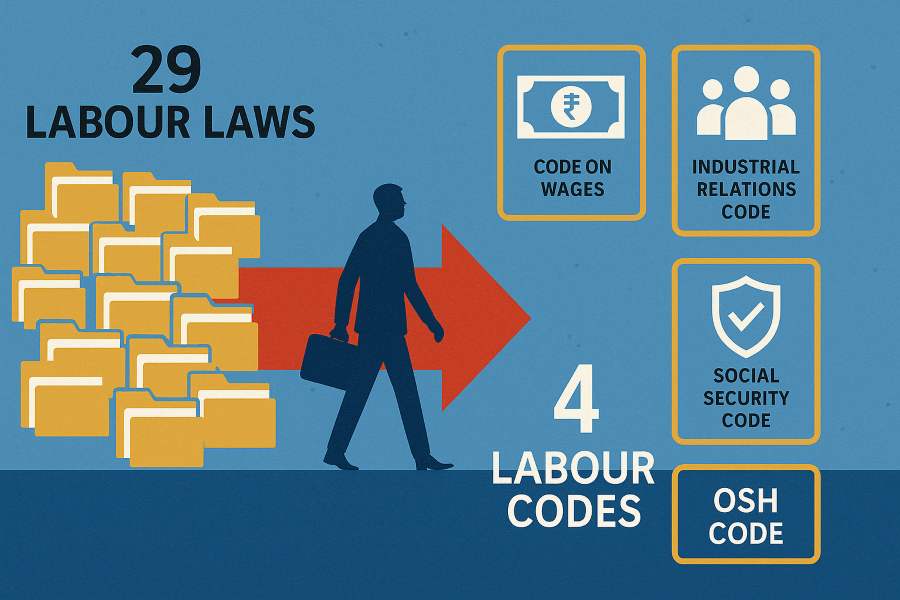
A closer look at how the consolidation of 29 labour laws into four modern Codes will reshape wages, social security, workplace conditions and industrial relations across India.
INDIA’S LABOUR FORCE has always been one of the strongest pillars of the nation’s economic and social architecture. Yet for decades, the legal framework governing this vast workforce remained scattered across laws written in the pre-Independence and early post-Independence era.
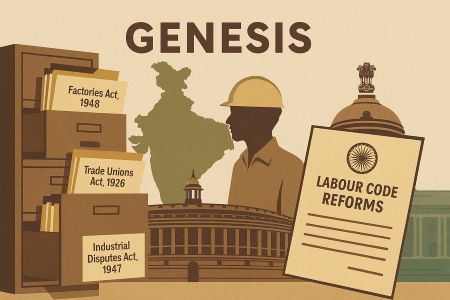
These laws were drafted for a very different industrial ecosystem and gradually became fragmented, overlapping and increasingly out of sync with technological developments, new forms of employment and the scale of India’s workforce.
It is against this backdrop that the Government of India undertook one of the most ambitious labour reforms in independent India: the consolidation of twenty-nine central labour laws into four comprehensive Labour Codes.
This major codification exercise was based on the recommendations of the Second National Commission on Labour, which had stressed the need to group multiple labour legislations into a smaller set of codes in order to simplify compliance and modernise the regulatory framework.
From Twenty-Nine Laws to Four Codes
The four Codes—the Code on Wages (2019), the Industrial Relations Code (2020), the Code on Social Security (2020) and the Occupational Safety, Health and Working Conditions (OSH) Code (2020)—were enacted after extensive consultations with trade unions, industry bodies, employers and experts.
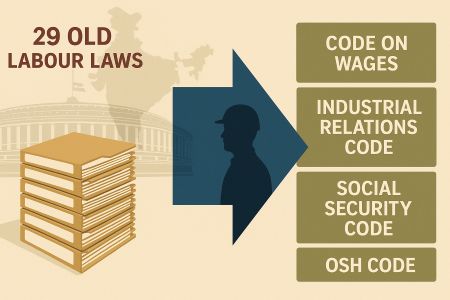 The Central Government notified them for implementation on 21 November 2025, marking a significant moment in India’s economic reform process.
For decades, employers and workers were required to navigate a maze of definitions, registrations, authorities and compliance obligations spread across different legislations.
The consolidation into four Codes is intended to streamline this landscape by introducing uniform definitions, single registrations, single returns and digital mechanisms for licensing, inspection and compliance. The aim is to create a transparent, technology-enabled and predictable regulatory environment while strengthening the rights and welfare of workers.
Why Reform Was Necessary
India’s earlier labour laws were conceived in an era when the economy was centred on factories, plantations, mines and traditional industrial production. The rise of the services sector, the gig and platform economy, flexible and fixed-term employment, digital workplaces and increased female labour participation required a fresh legislative approach.

Complex compliance requirements and multiple overlapping authorities also discouraged investment and made enforcement inconsistent across states.
The new Codes attempt to address these challenges by modernising provisions, widening social protection and creating a unified system that supports both worker welfare and industrial growth.
By bringing all categories of workers—including unorganised, gig and platform workers—within a single social security framework, the reforms seek to ensure that India’s labour laws reflect the realities of a rapidly shifting economy.
What Each Code Brings to the Table
The Code on Wages rationalises four earlier laws relating to wages, bonus and equal remuneration. For the first time, minimum wages are applicable to all workers across all sectors, and the Code establishes a uniform definition of wages that reduces disputes and confusion. It also mandates timely payment of wages and simplifies employer obligations.
The Industrial Relations Code merges the laws governing trade unions, industrial disputes and conditions of employment. It recognises the need for stable industrial relations in a growing economy and attempts to balance the rights of workers with the need for operational flexibility in industry.
Processes relating to dispute resolution, standing orders and recognition of trade unions have been standardised, allowing for more certainty and transparency.
The Code on Social Security is perhaps the most far-reaching of all the reforms. By integrating nine earlier laws, it extends social security to workers who had traditionally remained outside the safety net, such as gig workers, platform workers and unorganised sector workers. Facilitator-based compliance, digital registration, Aadhaar-linked benefits and unified social security funds mark a decisive shift towards inclusive welfare.
Also Read: Global Income Disparity Is Deepening
The OSH Code brings together thirteen laws relating to workplace safety, health and working conditions. It mandates free annual health check-ups for workers above forty years of age, simplifies licensing for establishments and allows women to work night shifts with adequate safeguards. By standardising welfare and safety norms across industries, it seeks to ensure dignified and secure working environments.
A Changing Landscape
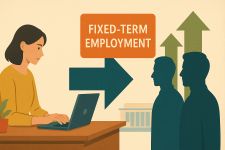
These reforms promise to reshape labour markets in ways that touch almost every sector. An important feature is the formalisation of employment: appointment letters have now become mandatory, and fixed-term employment is recognised with pro-rata gratuity entitlement after just one year of service.

The Codes also reduce the number of imprisonable offences from eighty-seven to twenty-two, and most of these are compoundable, signalling a shift towards corrective rather than punitive enforcement.
The real estate and construction sector, which relies heavily on contract labour, is likely to see significant changes. Contract workers can no longer be engaged in core activities, and principal employers must provide social security and gratuity benefits. This may raise costs for developers but is expected to improve long-term workforce stability and safety.
Also Read: Politics, Prices, and the People’s Pain
Manpower service providers may also face higher financial outflows due to enhanced social security obligations, including gratuity and severance benefits calculated on at least fifty percent of remuneration. While this increases immediate costs, the move aims to reduce attrition and improve productivity.
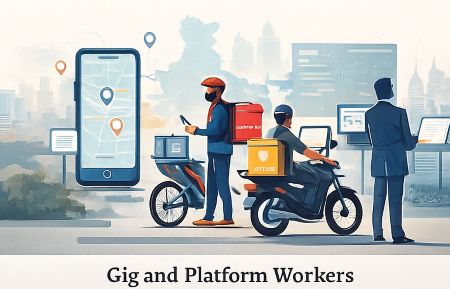
Perhaps the most transformative aspect of the new framework is the recognition of gig and platform workers.
Companies such as Amazon, Flipkart, Zomato, Swiggy and quick-commerce platforms will now contribute a small share of their turnover towards social security for gig workers.
Benefits will be delivered through direct transfers, with Aadhaar-based e-Shram registration acting as the backbone of the system.
Economic Impact and the Road Ahead
Studies, including those by the State Bank of India, indicate that the Labour Codes could generate millions of new jobs in the medium term, reduce unemployment and expand social security coverage to nearly 85 percent of the workforce.
The reduction of multiple returns to a single return, the move towards digital filing, and uniform definitions are expected to significantly reduce compliance burdens for businesses.

At the same time, the reforms have elicited mixed responses. Industry groups worry about increased labour costs, while trade unions fear that greater flexibility may weaken job security.
However, the Codes include mechanisms for grievance redressal, tripartite committees and specialised tribunals to address worker concerns.
Since labour is a concurrent subject, both the Centre and states must frame rules under these Codes. Most states are preparing rules that are broadly aligned with central guidelines, and the full implementation process may take a few more months.
Once operational, the Codes are expected to usher in a more predictable, transparent and harmonised labour regulatory environment.
Towards a Modern Labour Ecosystem
In essence, India’s new Labour Codes represent an effort to balance the twin goals of promoting economic growth and ensuring worker welfare. They attempt to create a framework that recognises the realities of a dynamic labour market while safeguarding the dignity, safety and social protection of workers.
 The reforms are designed not merely to reduce compliance for employers but to build a system that is fairer, more coherent and better aligned with contemporary challenges.
If implemented effectively, the Codes could transform India’s labour landscape—encouraging investment, improving industrial relations, enhancing productivity and empowering millions of workers across sectors.
They mark a significant step toward a more inclusive, organised and future-ready labour market that supports national development in the decades ahead. 
__________
Also Read:
Are Bombay High Court Officials Unaware of Amended Court-Fee Law?
Complaint Against Lawyers? Pay ₹6,500 First, Says Bar Council of Punjab & Haryana

Dr. Sanjiv Agarwal
The author is a chartered accountant, company secretary and D.Litt. scholar who writes on corporate laws, taxation and economic reforms.
Disclaimer : PunjabTodayNews.com and other platforms of the Punjab Today group strive to include views and opinions from across the entire spectrum, but by no means do we agree with everything we publish. Our efforts and editorial choices consistently underscore our authors’ right to the freedom of speech. However, it should be clear to all readers that individual authors are responsible for the information, ideas or opinions in their articles, and very often, these do not reflect the views of PunjabTodayNews.com or other platforms of the group. Punjab Today does not assume any responsibility or liability for the views of authors whose work appears here.
Punjab Today believes in serious, engaging, narrative journalism at a time when mainstream media houses seem to have given up on long-form writing and news television has blurred or altogether erased the lines between news and slapstick entertainment. We at Punjab Today believe that readers such as yourself appreciate cerebral journalism, and would like you to hold us against the best international industry standards. Brickbats are welcome even more than bouquets, though an occasional pat on the back is always encouraging. Good journalism can be a lifeline in these uncertain times worldwide. You can support us in myriad ways. To begin with, by spreading word about us and forwarding this reportage. Stay engaged.
— Team PT